St Julian’s with Kids: Where to Stay, Swim and Walk
St Julian’s is difficult to describe with a single label. Within a relatively small area, quiet Balluta Bay, restaurant-lined Spinola Bay, the sandy beach at St George’s Bay and Paceville — Malta’s main nightlife district — all sit side by side. For families, that compactness can be either a major advantage or a real problem: choose the right base and you can spend most of the day on foot; choose the wrong street and you may end up with music and crowds outside well past midnight.
That is why a family stay here is better planned around the exact area rather than a generic list of things to see in St Julian’s. Some families want a beach within a five-minute walk, others need a calm seafront for stroller-friendly outings, while others value easy connections to Valletta or Sliema. Location has a direct impact on how convenient St Julian’s will feel with children.
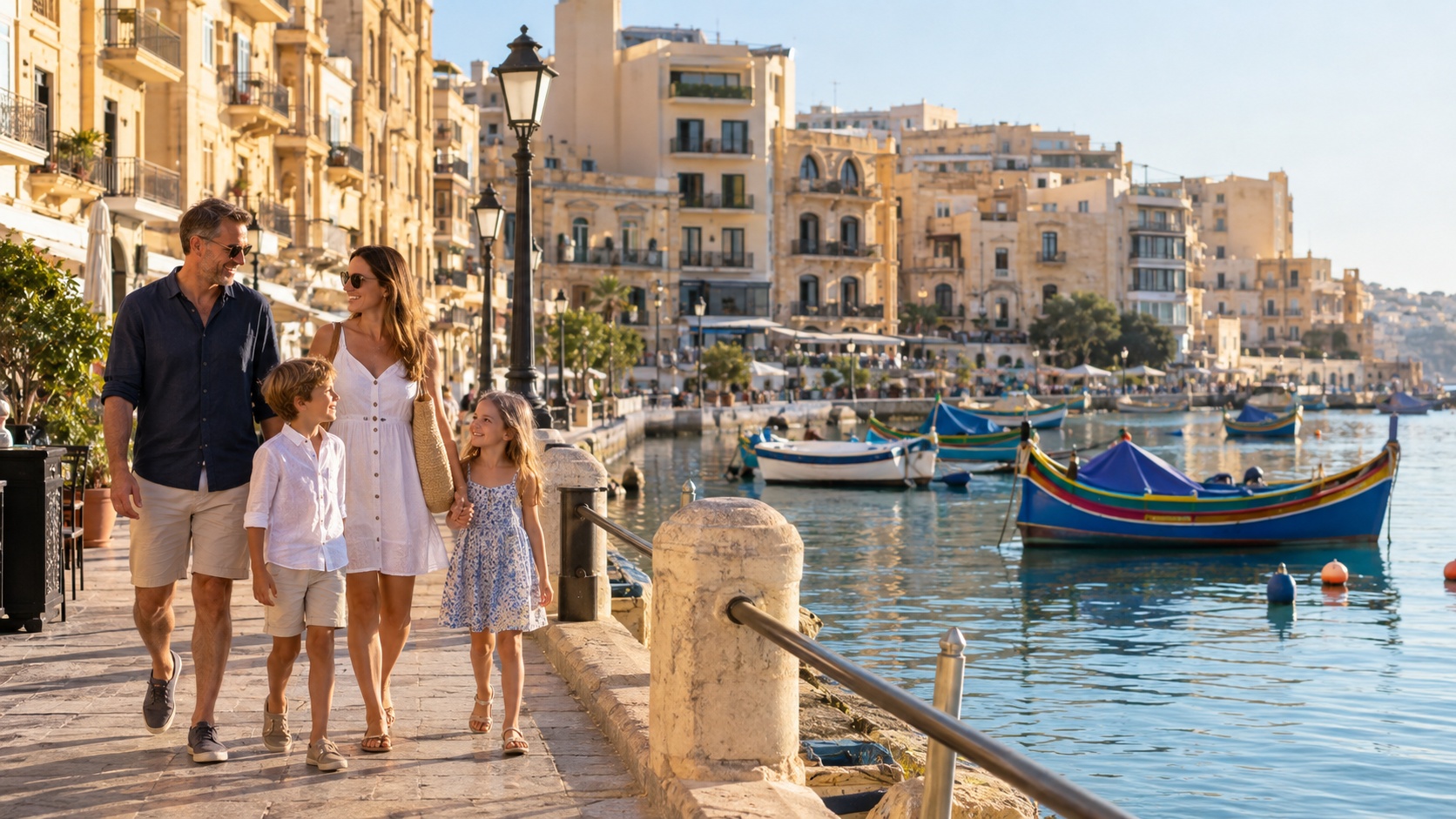
Where to Stay in St Julian’s: Four Areas Compared
Balluta Bay is the calmest option for families who want to stay by the sea, walk along the promenade and avoid the nightlife district every evening. From here, it is easy to continue on foot towards Sliema or Spinola Bay, and there are plenty of cafés nearby. The trade-off is the lack of a large sandy beach, so Balluta works best for families who value walks and quieter evenings more than swimming right outside the hotel.
Spinola Bay is livelier, but still one of the more convenient parts of St Julian’s for families. Restaurants, bus stops, the waterfront promenade and the bay itself are all concentrated here. Its position is useful: Balluta is close, and St George’s Bay is also within walking distance. Spinola, however, is not a beach area in the conventional sense, so it is a better choice for location and atmosphere than for swimming.
St George’s Bay is worth considering primarily for its sandy beach. It is one of the few places in St Julian’s where a family can leave the hotel and reach a proper sandy shoreline within minutes. That is a major advantage with children, but there is a downside: the beach sits next to Paceville, so the surrounding streets become noticeably noisier in the evening.
Paceville is the most questionable choice for a family base. During the day it can be convenient for walking to St George’s Bay, shops and restaurants, but in the evening it becomes the centre of St Julian’s nightlife. Bars, clubs and heavy foot traffic make it a poor fit for families with young children, especially if the room faces a busy street. Staying here only makes sense when the hotel is well insulated from noise and being close to the beach matters more than having quiet evenings.
| Area | Main advantage | Main drawback | Best for |
|---|---|---|---|
| Balluta Bay | Quieter atmosphere, pleasant promenade, close to Sliema | No large sandy beach | Families with toddlers and strollers |
| Spinola Bay | Central location, restaurants and transport nearby | Busier in the evening | Families who prefer to get around on foot |
| St George’s Bay | Sandy beach close to hotels | Next to Paceville | Families with older children and beach-focused trips |
| Paceville | Beach, restaurants and entertainment nearby | Noisy nightlife | Suitable for families only in carefully chosen hotels |
If quiet nights and easy walks are the priority, Balluta Bay or the lower part of Spinola Bay usually make more sense. If a sandy beach matters more, St George’s Bay is the stronger option. Paceville is better treated not as a default family base, but as an area where the exact hotel location matters enormously.
How to spend a day with children without crossing the whole island
St Julian’s works well with a simple family rhythm: a walk in the morning, indoor time or a break during the hottest hours, then the sea later in the day. This is especially useful in summer, when trying to spend the entire day outdoors can quickly turn sightseeing into an exercise in managing heat and tired children.
A good morning route starts at Balluta Bay and follows the waterfront towards Spinola Bay. It is short, there are plenty of places to stop, and the boats, jetties and constant activity on the water usually keep children interested without making the walk feel like another adult-oriented promenade. There is no need to continue all the way to Paceville: by midday, changing the pace is often the better option.
Spinola Park is home to The Kids Park, an indoor play area that is especially useful during hot weather or on one of Malta’s occasional rainy days. It is aimed mainly at children up to around nine years old and includes soft-play structures, slides and climbing areas. An adult has to remain with the child, and socks are required for both children and accompanying adults. This is one of those practical places that can genuinely make the middle of the day easier rather than simply padding out a sightseeing list.
After around 4–5 pm, it makes sense to head back towards the sea. If sand is the priority, St George’s Bay is the obvious choice. If the child is already a confident swimmer and the family prefers rocky swimming spots, continuing along the coast towards Sliema is another option: Exiles has access points to the sea close to a children’s playground. For toddlers, though, it is less convenient than a sandy shore.
Where to swim — and where it is better just to walk
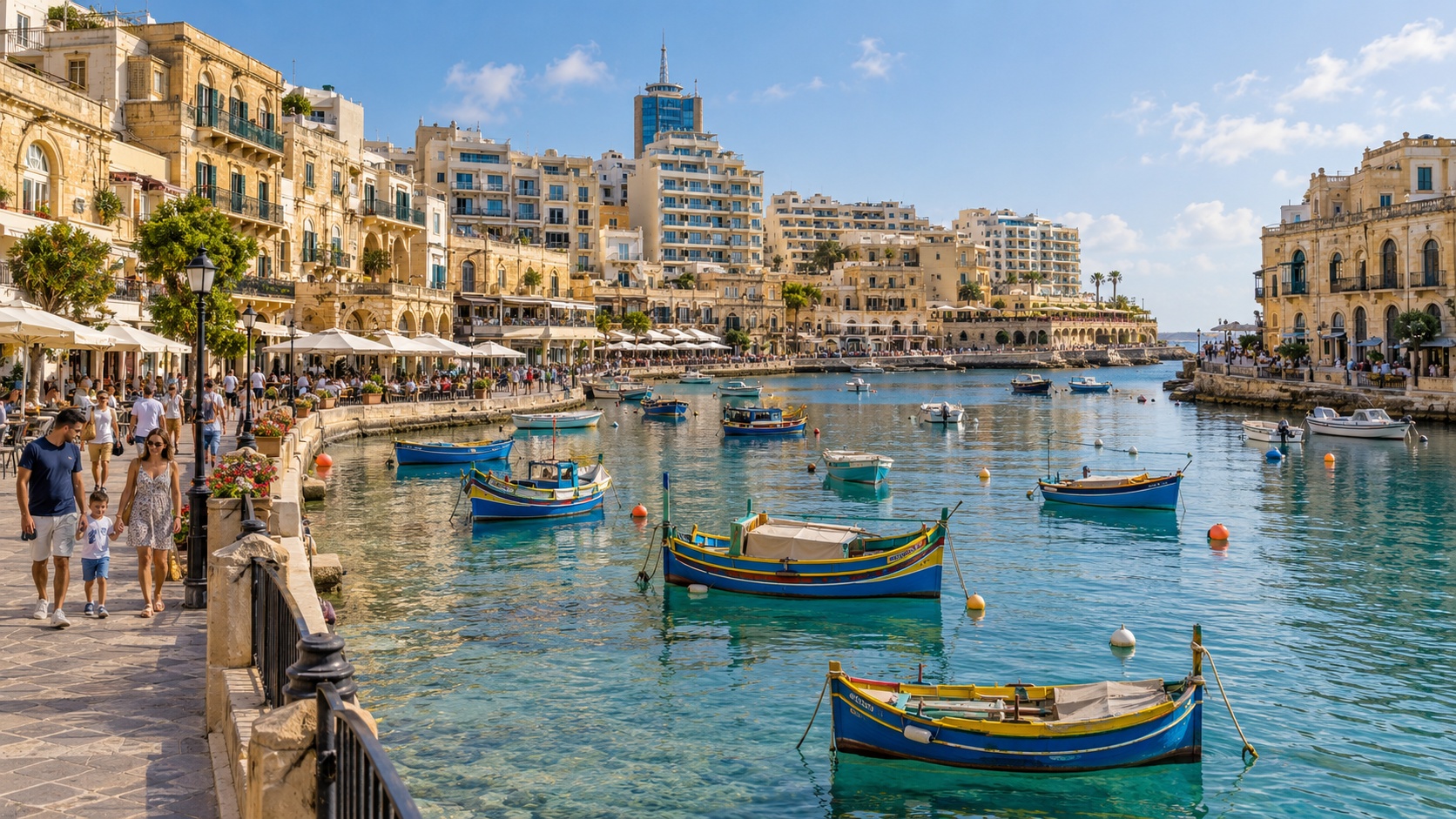
One of the easiest mistakes to make in Malta is assuming that every attractive bay is also a good swimming beach. St Julian’s is a clear example. Spinola Bay looks inviting, but part of the harbour is not recommended for swimming. It is primarily a boating and mooring area, and works better for walks than for a family beach session.
For a straightforward family beach day, St George’s Bay is the easier option. It is an official sandy bathing area with government water-quality monitoring points. Conditions are checked during the bathing season, so it is more useful to look at the latest status for the specific location than to rely on old traveller reviews. Water-quality classifications can change during the season.
Balluta Bay should not automatically be treated as a substitute for St George’s Bay simply because it is closer to the quieter residential streets. According to Malta’s monitoring system, water quality at individual Balluta points can sometimes be worse than at nearby bathing areas. It is an excellent place for a walk, but swimming decisions are better based on current information.
If you want a nearby alternative, Exiles in Sliema works well for families with older children. It has rocky bathing platforms and sea access, with a playground nearby. That creates a useful split: one adult can stay with a younger child at the playground while the other swims with an older child.
St Julian’s after dark: Paceville, casinos and noise
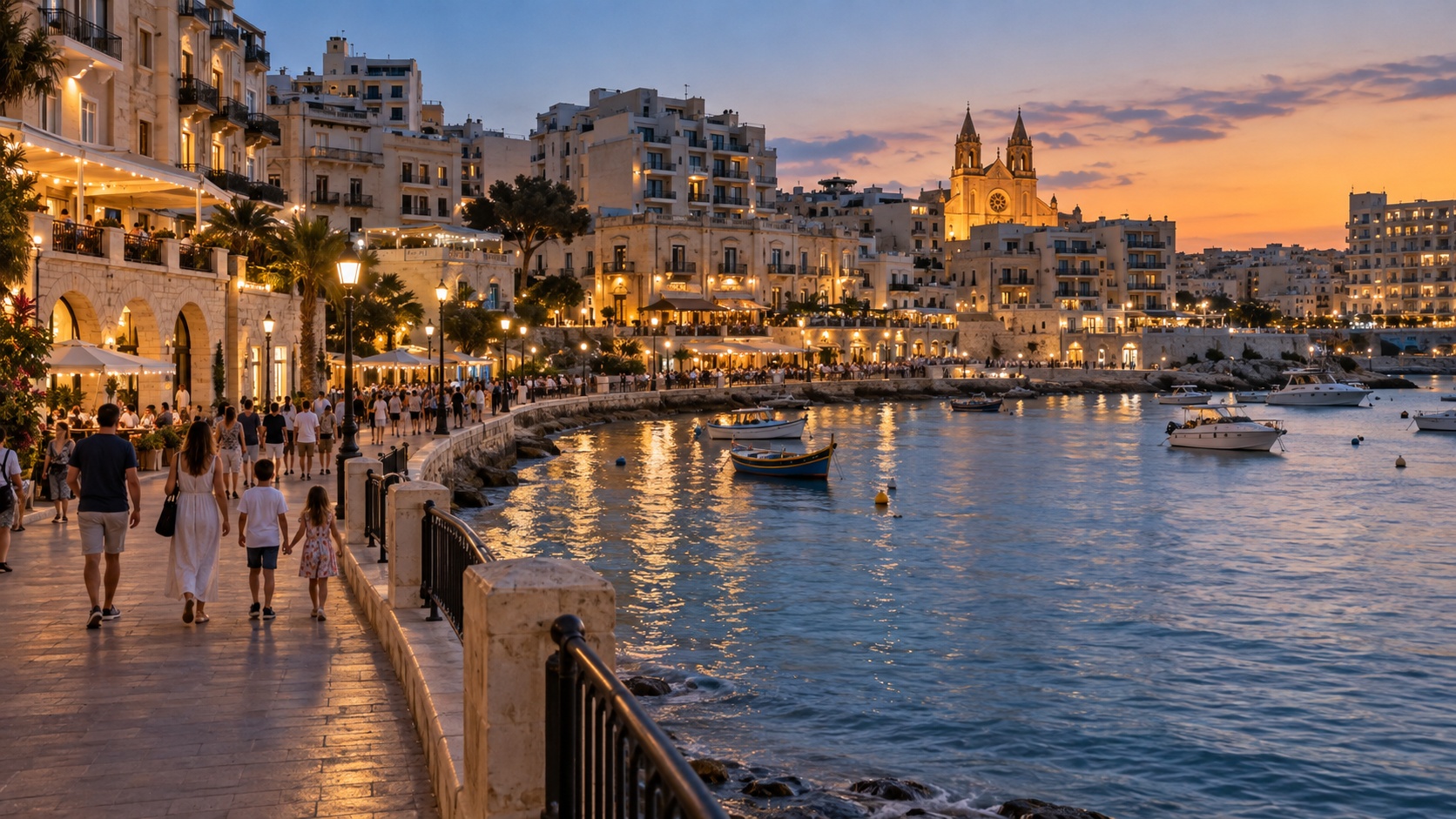
St Julian’s changes quickly after sunset. Balluta Bay still feels like a place for seafront walks and dinner terraces, Spinola Bay becomes busier as restaurants fill up, while Paceville gradually turns into a nightlife district in its own right. Bars, clubs, gaming venues and casinos are concentrated within a relatively small area; around Dragonara Point, adult entertainment sits alongside large hotels and the seafront. For families, understanding that geography matters: a quiet dinner and a street full of loud music can be less than ten minutes apart on foot.
St George’s Bay itself should not be treated as if it were the same thing as Paceville. The beach works perfectly well for an ordinary family visit, while most nightlife is concentrated on the neighbouring streets and becomes more intense later in the day. In daylight, walking through Paceville may simply be the shortest route to the beach, a restaurant or the shopping centre; late at night, the same streets are filled with people heading to bars and clubs. If children need an early bedtime, accommodation directly on Santa Rita, St George’s Road or Wilġa is best avoided unless the hotel is specifically known for good sound insulation.
When St Julian’s is a better family base than other parts of Malta
St Julian’s is not the best choice because it has a huge number of children’s attractions within the town itself. Its real strength is that it is easy to build a comfortable day here without a car or long transfers. Morning can mean the promenade, the hottest hours can be spent indoors or resting, and the evening can be used for the beach and dinner. When the family wants a change of scenery, Sliema, Valletta and other parts of the island are easy to reach.
The area is linked to Malta International Airport by direct Airport Direct TD2 and TD3 services. That is especially useful when travelling with children and luggage because there is no need to go into Valletta first and change buses. For everyday travel, however, it is worth remembering that journey times in Malta can depend heavily on traffic, so a long cross-island trip is best not squeezed between two activities with fixed start times.
St Julian’s works particularly well in three situations:
- the family wants to combine seaside walks and swimming rather than choose a purely beach-based stay;
- several trips to Valletta and Sliema are planned, but renting a car is unnecessary;
- the children do better with several shorter activities than with an entire day in one park or on one beach.
If the main goal is a quiet sandy beach, daily swimming and early evenings, there are parts of Malta where that is easier to find. St Julian’s stands out not for tranquillity or for the number of children’s attractions, but for how many different types of activity fit into a compact area. That is also why choosing the right part of town matters so much: Balluta and Spinola produce one kind of holiday, St George’s Bay another, and Paceville after dark something else entirely.